From Vision to Weekly Focus: How Product Organisations Actually Move Their North Star Metric

by Sam Adesoga·On July 7th, 2026•Updated on August 7th, 2026
Share to


In most product organisations, it is easy to confuse having a bold Vision with having a plan. Leaders set ambitious five-year statements, teams nod along, and everyone returns to their sprint boards without a clear line between the work in front of them and the outcome the organisation is chasing. Over the years, we have seen this gap between Vision and daily execution quietly stall more transformation efforts than almost any other single factor.
This post walks through how a Product Vision, a North Star Metric, and an OKR Tree fit together in practice, and the discipline required to keep multiple teams from working against each other along the way.
Start with a Vision, but don't wait for a perfect one. Every product should have a Vision, an ambitious statement that guides the team and the organisation for the next five years or more. Alongside it sits the North Star Metric, the single measure the organisation rallies around to track progress towards that Vision. This pairing is foundational, but it does not need to be locked down before any work begins. Vision and strategy should sharpen as the organisation builds and learns; what matters is that some articulated Vision and North Star exist to build towards, not that they are perfect on day one.
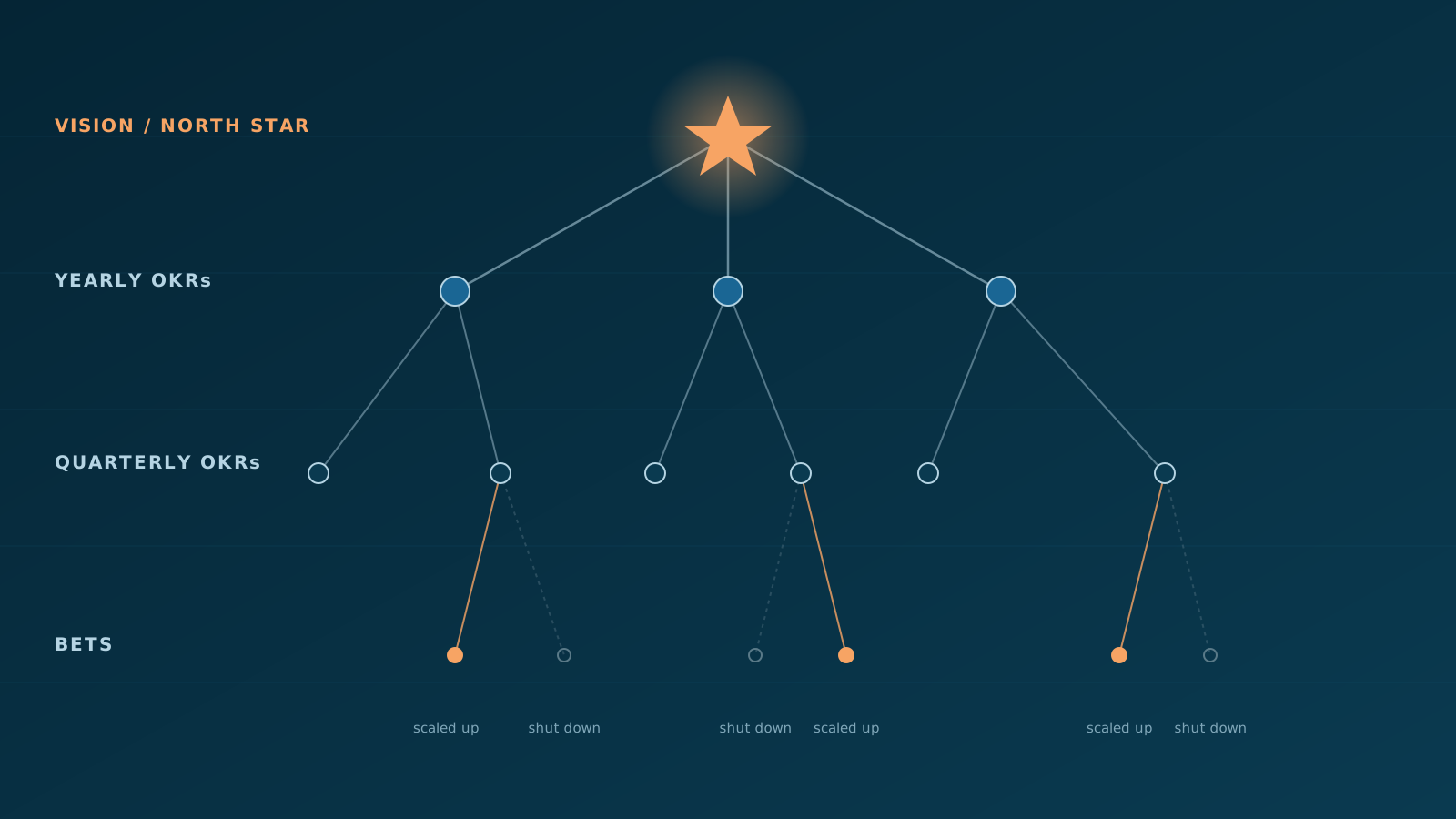
Decompose the North Star, because it moves too slowly to manage directly. North Star Metrics are lagging by nature. It takes years of building, releasing, and improving products before an organisation sees real movement in the number. That is why we recommend an OKR Tree: breaking the North Star Metric into Yearly Objectives and Key Results, and then breaking those Yearly OKRs down further into Quarterly OKRs. The result of this exercise is a set of hypotheses about how the value behind the North Star can be delivered and validated, not a fixed set of instructions handed down from leadership.
Add input metrics and guardrails, or you will not know what is actually working. A North Star Metric on its own tells you very little about which levers to pull. Alongside it, organisations need a small set of input, or leading, metrics that predict eventual movement in the North Star, and counter-metrics that act as guardrails. Counter-metrics matter because teams under pressure can hit a target in ways that quietly damage something else that matters, driving engagement up while retention or trust erodes underneath it. This is the same trap described by Goodhart's Law: once a measure becomes a target, it stops being a reliable measure. Building in guardrails from the start protects the organisation from celebrating the wrong win.
Make the OKR Tree a conversation, not a cascade. It is tempting to treat OKRs as something leaders define and teams simply inherit. In our experience, this is where OKR programmes lose their power. Leaders bring context on strategy and the North Star; teams bring context on what they are learning from users, data, and the market day to day. OKRs work best when they are negotiated between the two, not assigned downward. Treated as a pure cascade, the OKR Tree collapses into a KPI target list, and teams lose the ownership that makes the whole exercise worthwhile.
Remember that even a Quarterly OKR is still an outcome, not a task. No team can act on a 5-year North Star Metric directly, and the same is true one level down, nobody can act on a Yearly OKR directly either. Quarterly OKRs are gradual enough to create real focus, but they are still outcomes. The actual unit of work sits one level below that: the bets and initiatives teams run to try to move a given Key Result.
Let discovery run alongside strategy, not after it. Discovery, prototyping, and user research should not be treated as a downstream step that only kicks in once the OKR Tree is finalised. Continuous discovery should run in parallel with the OKR Tree itself, helping leaders and teams sense-check whether the Objectives and Key Results being set are the right ones, before and while they commit to them. Teams then use this ongoing discovery to identify the bets they believe will move their Quarterly Key Results. These are called bets deliberately, because they carry no guarantee of success. Features that build confidence the right lever is being pulled are scaled up; features that fail to move the needle, without damaging the guardrail metrics, are shut down.
Don't pull more than one lever at a time. This is the discipline organisations most often skip, and it is where a lot of good measurement gets wasted. When several teams run bets against the same metric or the same user segment at the same time, it becomes impossible to tell which bet actually caused any movement you see afterwards, and organisations end up scaling the wrong thing on false confidence. Every Key Result should have a single clear owner, and wherever two or more bets could plausibly move the same lever, they should be sequenced rather than run in parallel. It is a slower way of working in the short term, but it is the only way to trust what the North Star Metric is actually telling you when it finally moves.
At ValueHut, we help product organisations build the connective tissue between Vision, North Star Metrics, and the day-to-day work of their teams. If your OKRs feel disconnected from your strategy, or your teams are unsure which bets are actually working, get in touch for a no-fee conversation. Further reading
Doerr's Measure What Matters,
Wodtke's Radical Focus,
Cagan's Inspired,
Torres's Continuous Discovery Habits,
Amplitude's North Star Playbook
Share to